EGYPT, DECEMBER 2003
Photo journal of my time in Egypt, during December 2003. All photos were taken with disposable cameras, in order to remain discreet in second and third world environments.
I wish I had taken more pictures of people; the Egyptians (like the Moroccans) are a wonderfully warm people, and I was constantly greeted by folks young and old, some of whom I briefly befriended. Moreover, like so many of the most intense experiences, it’s impossible to capture the infinity of the Sahara with even the most expensive camera equipment.
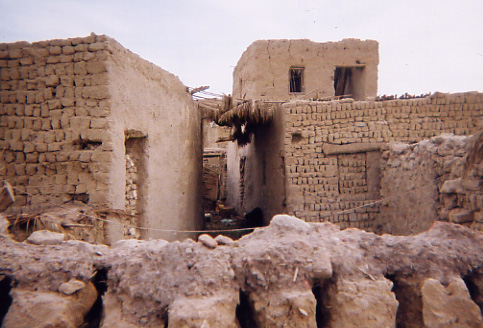
Bawiti al-Qasr: I spent three days traveling the western desert circuit of oases in the Sahara, which dominates over three quarters of Egypt’s land mass. The first of the four is Bahariya. This picture was taken literally across the street from my very modern hotel there in the capital of the oasis, Bawiti. This is representative of the majority of Bawiti’s buildings. Along the main roads were some much-tarnished attempts at new infrastructure, but most of the town was waterless, powerless mud brick houses like this.
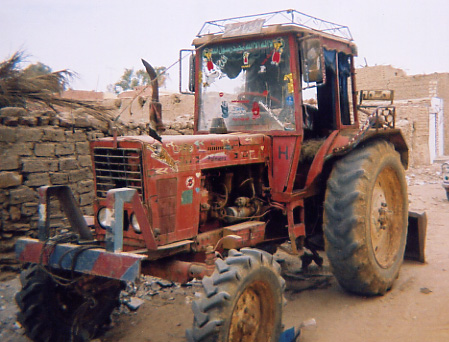
Most vehicles in Egypt are very old (20 years at least) and papered over with decals or other makeshift decoration. This tractor was almost a caricature of that phenomenon.
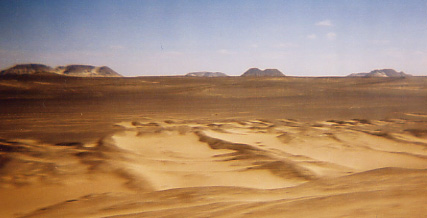
Black Desert: Leaving Bahariya for the Farafala oasis, you go through a stretch of desert like this, where there is some sort of charred rock encrusting the vastness of the desert, giving it its name.
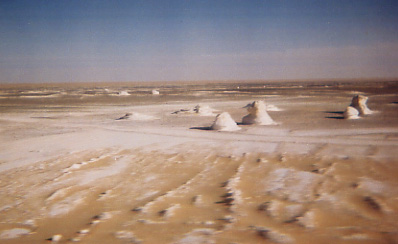
White Desert: Further along the same route, everything goes white. The rocks you see in the foreground are apparently only small examples of the larger, more bizarre shapes that the wind has made.
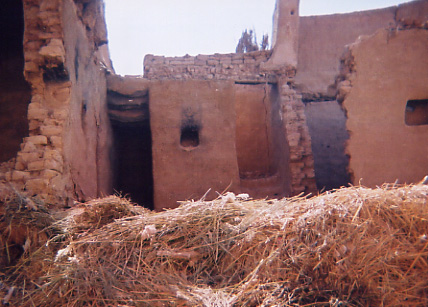
Mut al-Qasr: “al-Qasr” signifies an old part of town which used to be a fortress (qasr). In Mut, the capital of Dakhla oasis, the ruins were more substantial than in Bawiti, and largely more abandoned.
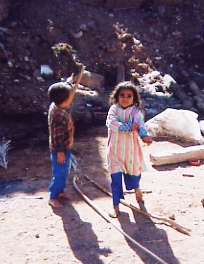
Children of al-Qasr: Though not always. I should have taken more pictures of children, because throughout the poorer areas, they would consistently approach you, unafraid, and typically joyful; begging was the exception and not the rule. They usually just wanted to say hello. This little boy attempted to get me to stay put while he went to fetch his papa.
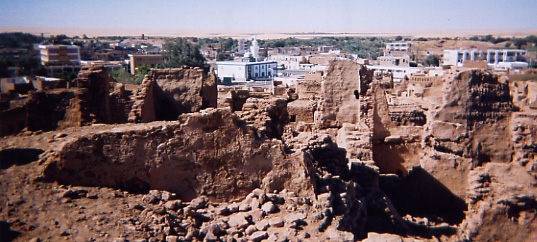
This was taken from the summit of the ruins in Mut, looking out towards the periphery of town. If you look closely, you can see the yellow band of sand just below the horizon. I decided to walk out to these dunes.
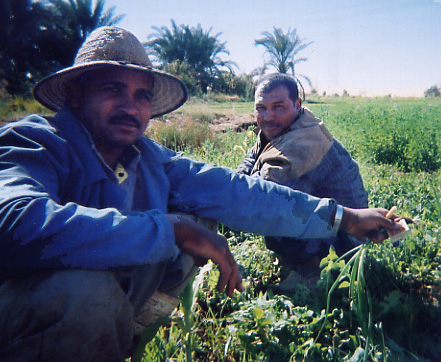
On the way out of town, I walked through about two miles of farmland, cultivated, like almost all Egyptian agriculture, by hand. At first, I was a bit apprehensive, as I was effectively walking across private property. But all of the men I met simply welcomed me. These two asked for a cigarette, and so we sat and took a break together. They partook of the Arabic tendency to offer gifts to strangers, and tried to give me some of the crops (green onions) that they were tending to.
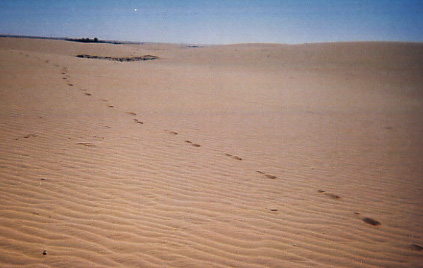
Hard to describe what it’s like to truly be out in the desert. Basking in infinite desolation? It was hard to tear myself away from this spot—and I was only barely on the fringes of the desert.
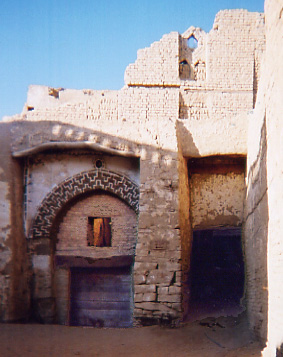
There is an actual village in the Dakhla oasis called, simply, al-Qasr. Its ruins are much more intact and advanced than the others. This photo shows why, in part, with actual wood-carved decoration above some of the doors. There were also some multi-story structures still intact, as you can see in the background of this photo.
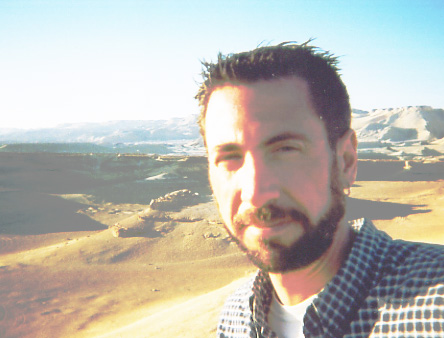
Like many folks, I had the misconception that an oasis was strictly greenery and palm trees. Technically, it’s just a valley in the desert where water is accessible, and so much of it is as sandy and desolate as the desert that surrounds it. This picture was taken on the hill behind al-Qasr, looking out towards the canyon walls that demarcate the oasis.